
Choosing a water tank is no longer only about deciding how many litres of water you need to store. For homes, commercial buildings and institutional facilities, the tank’s exposure to outdoor conditions, construction material, insulation system, water quality and intended use can all influence which storage solution makes sense.
One of the most important distinctions is between an Insulated Water Tank and a regular water tank. Both perform the basic function of storing water, but they are not thermally equivalent. A regular tank primarily provides storage, whereas an insulated tank incorporates a thermal barrier intended to reduce the rate of heat transfer between stored water and the surrounding environment.
This difference becomes particularly relevant when tanks are installed on exposed rooftops and terraces. As the surrounding temperature and solar exposure change throughout the day, heat can move between the tank, its contents and the environment. Insulation adds thermal resistance to this process, slowing heat gain or heat loss.
However, insulation should not be confused with refrigeration. An insulated tank does not actively produce cold water or guarantee one constant water temperature throughout the day. Its function is to reduce the rate of temperature change compared with an otherwise comparable uninsulated system.
This distinction provides a better starting point for deciding whether your property genuinely needs insulation.
What Is an Insulated Water Tank?
An insulated water tank is a storage system that incorporates an insulation layer or thermal barrier as part of its construction. The purpose of this layer is to restrict heat transfer between the water inside the tank and the external environment.
Depending on the engineering design, an insulated tank can contain several functional layers. One may provide the water-contact surface, another may contribute structural strength, while another provides thermal resistance. An external layer or enclosure may protect the insulation and overall assembly.
This means that the phrase “multi-layer tank” should not automatically be treated as synonymous with “better insulated tank.” The function and properties of the individual layers matter more than simply counting them.
The underlying principle is established thermal science. Heat flows when a temperature difference exists, and thermal resistance is used to restrict that heat flow. Therefore, if water inside a tank is cooler than the surrounding environment, an effective insulation system can slow the rate at which external heat reaches it. The same principle works in reverse when stored water is warmer than its surroundings.
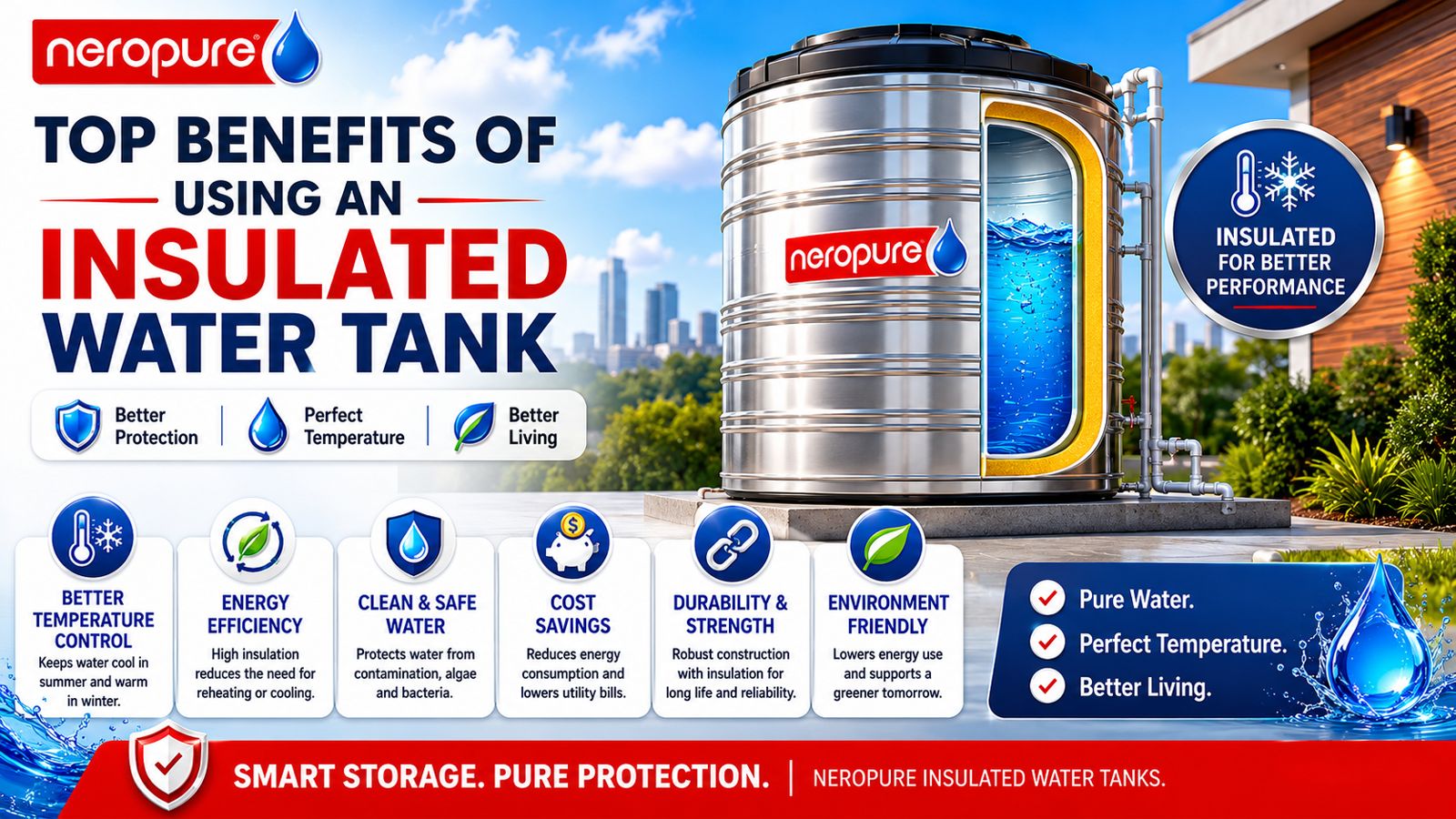
For Neropure, insulation is combined with stainless-steel water storage through its multi-layer thermal insulation technology. Its current product selection also distinguishes between tank model, insulation requirement and volume or dimensions rather than treating every installation as identical.
That approach is particularly relevant because the need for insulation can vary significantly between an exposed residential rooftop, a sheltered installation and a commercial or institutional application.
What Is a Regular Water Tank?
A regular water tank, in the context of this comparison, means a storage tank without a dedicated thermal-insulation system designed to significantly restrict heat transfer.
It can be manufactured from different materials, including polymers, stainless steel, reinforced concrete and other suitable tank materials. Its principal role is water storage.
This definition is important because regular does not mean plastic, just as insulated does not automatically mean stainless steel.
A Steel Tank, for example, can be insulated or uninsulated. Similarly, polymer-based tanks can incorporate foam or other layers intended to improve thermal performance. Tank material and tank insulation are therefore two separate technical characteristics.
This is where many online comparisons become confusing.
If a buyer compares an insulated stainless-steel tank with an ordinary plastic tank, there are actually several variables changing simultaneously: water-contact material, structural construction, insulation and potentially surface characteristics and installation requirements.
A technically useful comparison therefore asks two separate questions: What should my tank be made from? and Does my installation require a dedicated thermal barrier?
The answer to one should not automatically determine the other.
Insulated vs Regular Water Tank: What Is the Main Difference?
The fundamental difference is thermal resistance.
A conventional uninsulated tank is more directly influenced by heat transfer through its tank wall. An insulated tank introduces an additional thermal barrier intended to reduce that transfer.
Suppose water enters a rooftop tank in the morning at a temperature lower than the surrounding conditions. As the tank and its environment become warmer, heat can transfer towards the stored water. An effective insulation layer increases resistance to this heat flow, meaning the water temperature should change more slowly than it would in an otherwise comparable system without that insulation.
That does not mean the temperature remains unchanged indefinitely. The eventual thermal behaviour depends on several variables, including ambient conditions, solar exposure, initial water temperature, insulation properties, tank geometry, water volume and how frequently water enters and leaves the tank.
This is why claims such as “keeps water cold all day” need context and defined test conditions.
Neropure appropriately makes its temperature-performance positioning dependent on the particular model rather than suggesting that every tank produces an identical result under every condition.
Why Does Tank Insulation Matter in Hot Weather?
The relevance of insulation becomes easier to understand when considering a rooftop installation exposed to Indian summer conditions.
A tank positioned outdoors can be affected by solar radiation, surrounding air temperature and heat transfer through its external surfaces. As conditions around the tank become hotter than the stored water, there is a thermal driving force for heat to move towards the cooler water.
An Insulated Water Tank introduces resistance between these environments.
The practical objective is therefore not to manufacture cold water. It is to reduce unwanted heat gain and slow the rate at which stored water responds to external temperature changes.
For a homeowner, this can be relevant when water remains stored in an exposed rooftop tank for substantial periods before being used. For commercial and institutional facilities, thermal management may become more significant where water-temperature stability has operational importance.
The degree of benefit still depends on the specific installation. A tank exposed to strong sunlight for long periods faces different conditions from one installed under substantial shade or inside a protected utility area.
This is why installation environment should be considered before deciding whether additional insulation is worthwhile.
Does a Regular Water Tank Always Make Water Hot?
No. That would be an oversimplification.
The temperature of stored water is influenced by a combination of factors rather than by the absence of insulation alone. These include incoming water temperature, tank material and construction, solar exposure, ambient temperature, storage duration, water turnover and installation location.
A regular tank placed in a relatively protected environment can therefore behave very differently from the same type of tank installed on a fully exposed rooftop.
Similarly, the fact that one tank is made from steel does not, by itself, tell you exactly what temperature the stored water will reach.
Metals generally have substantially higher thermal conductivity than typical insulating materials, which is precisely why thermal insulation can be added around metal storage systems when reduced heat transfer is required. But the thermal performance of the complete tank depends on much more than the conductivity of its inner structural material.
Surface properties, wall construction, insulation thickness and type, exposure and tank geometry all contribute.
For this reason, comparing an insulated Steel Tank with an uninsulated steel tank is more technically meaningful when the question specifically concerns the effect of insulation.
Temperature Stability: Where an Insulated Tank Has the Advantage
If reducing heat transfer is a priority, a properly designed insulated tank has a clear functional purpose that an equivalent uninsulated tank does not: additional thermal resistance.
That can be useful in both directions.
During hot conditions, insulation can slow heat gain into cooler stored water. Where stored water is warmer than its surroundings, insulation can slow heat loss. The principle is the same even though the direction of heat flow changes.
This characteristic explains why thermal insulation is widely used beyond domestic water storage. Industrial tanks, process vessels, chilled-water systems and hot-water storage systems use insulation where unwanted heat transfer needs to be controlled.
However, the significance of this benefit depends strongly on the application.
A residential cold-water tank does not necessarily require the same degree of temperature control as an industrial process-water system. Claims about industrial energy savings should therefore not automatically be transferred to an ordinary household installation.
In an industrial system where water is actively heated or chilled, reducing thermal losses can reduce the amount of energy required to restore or maintain process temperatures. In a domestic tank containing ordinary supply water with no active heating or cooling system attached, the primary benefit is better thermal resistance rather than an automatic, measurable reduction in electricity consumption.
That distinction keeps the comparison technically accurate.
Does Insulation Also Make the Water Safer?
Not automatically.
Insulation and water hygiene solve different problems.
Thermal insulation controls heat transfer. Water safety depends on factors including source-water quality, treatment where required, tank construction, protected openings, plumbing, cleaning and preventing contamination during storage.
WHO guidance on household water treatment and safe storage specifically addresses the risk of water becoming contaminated or recontaminated during storage. Safe storage therefore requires appropriate tank design and handling; insulation alone should never be treated as a purification technology.
If contaminated water enters an insulated tank, the insulation does not remove dissolved chemicals, microorganisms or other contaminants.
This matters when evaluating phrases such as “healthy water” or “pure water.” A high-quality tank can be engineered to provide a suitable environment for storing appropriately supplied water, but storage and treatment remain different functions.
For buyers considering Neropure, this means the decision should involve both thermal performance and the suitability of the stainless-steel water-contact system for the actual source water.
Insulated Water Tank vs Regular Tank for Rooftop Installation
Rooftop installations are one of the strongest use cases for evaluating insulation because environmental exposure can be significant.
An exposed rooftop tank may experience direct sunlight, elevated surface temperatures and changing ambient conditions throughout the day. An insulation system provides an additional thermal barrier between those conditions and the water inside.
A regular tank can still perform its fundamental storage function effectively when properly specified and installed. The question is whether controlling the rate of temperature change is important enough for the property to justify choosing a thermally insulated configuration.
For households where tanks remain exposed for extended periods and uncomfortable water temperatures are a recurring concern, thermal performance deserves greater consideration. For commercial properties, hotels, healthcare facilities, educational institutions and other buildings with significant water demand, storage duration and operating requirements should also be assessed.
Neropure's insulated stainless-steel approach is designed around precisely this additional consideration: combining water storage with a dedicated thermal-insulation system rather than relying solely on the tank wall.
The comparison, however, does not end with temperature.
Material Matters as Much as Insulation
Thermal performance is only one part of the comparison. Once you understand what insulation changes, the next question is what the tank itself is made from.
This distinction matters because insulation and tank material perform different functions. Insulation primarily influences heat transfer, while the water-contact material affects factors such as corrosion behaviour, cleanability, mechanical characteristics and suitability for particular water conditions.
Regular water tanks can be manufactured from polyethylene, stainless steel, reinforced concrete and other materials. Likewise, an insulated tank can use different structural and water-contact materials. It is therefore inaccurate to assume that every regular tank has the same properties or that insulation automatically determines the quality of the surface touching the water.
For Neropure, the two characteristics come together through stainless-steel construction and multi-layer thermal insulation. This allows the buying decision to address both the water-contact environment and thermal performance.
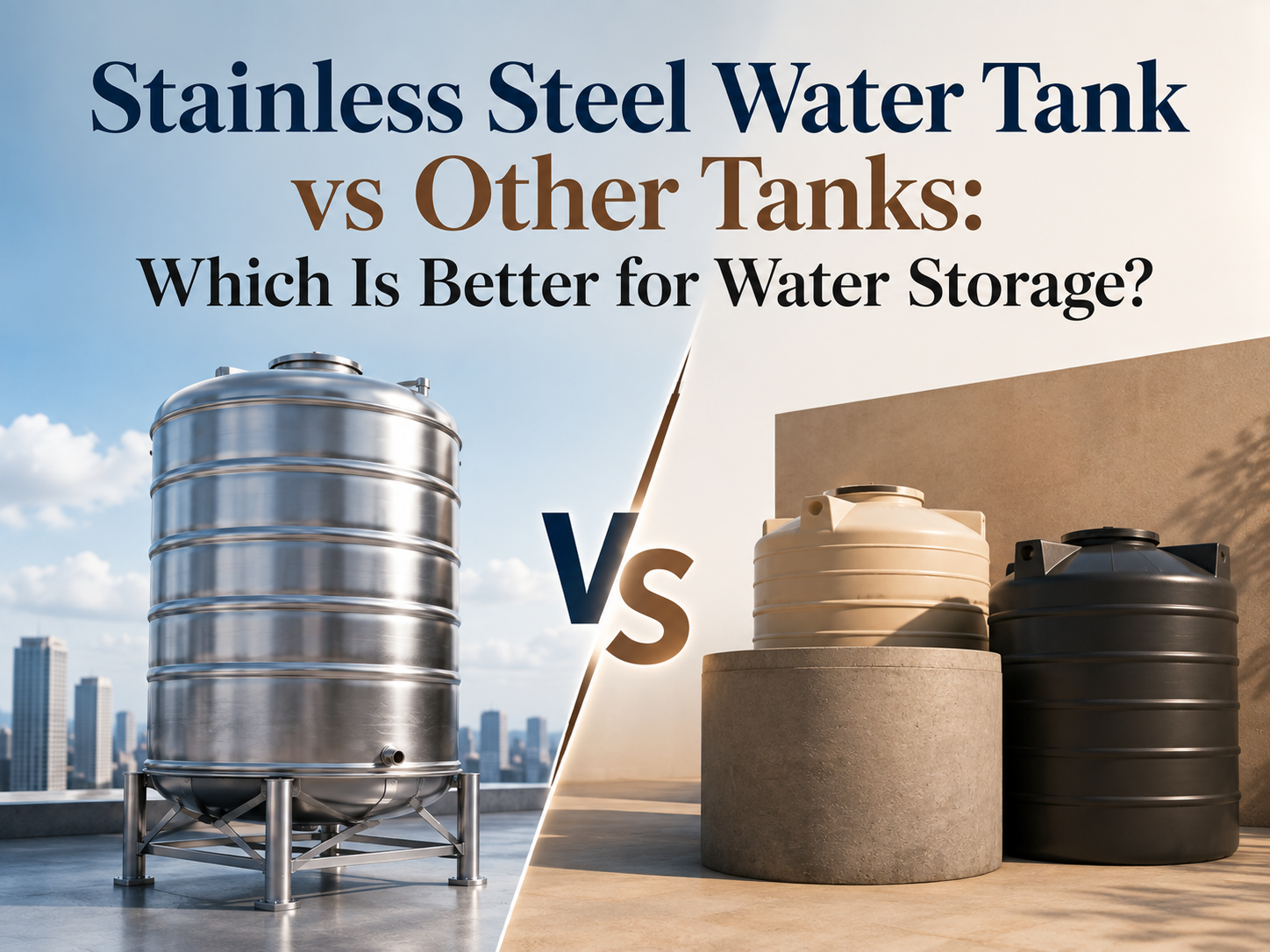
Stainless Steel vs Conventional Tank Materials
Stainless steel is widely used for applications where durability, corrosion resistance and cleanability are important. However, “stainless steel” is not one single material. It describes a family of alloys, and their performance can differ according to grade and operating environment.
This is especially relevant for water storage because water chemistry can influence material performance.
Stainless-steel grades such as 304 and 316 are used across potable-water applications. Grade selection should nevertheless consider the actual water chemistry, including factors such as chloride exposure rather than assuming that one grade is automatically suitable for every water source.
For homeowners, this means an Insulated Water Tank should not be selected simply because “stainless steel” appears in the product description. The water-contact grade, source-water characteristics and intended application should all form part of the specification.
This is particularly important where borewell or groundwater is used. Groundwater chemistry can differ considerably between locations, making recent water-quality information valuable when specifying a long-term storage system.
Neropure itself places operating conditions around some of its service-life positioning, including reference to potable home-supply water with TDS below 200 ppm. Such conditions should be discussed during product selection rather than assuming identical performance irrespective of source-water characteristics.
Is a Steel Tank Better Than a Regular Plastic Tank?
There is no technically sound answer that says one material is universally better for every property.
Polyethylene tanks have practical characteristics such as low weight and corrosion resistance and are widely used for domestic water storage. Stainless-steel tanks offer a different material system and can provide long-term durability and cleanable internal surfaces when the correct grade is selected and the tank is properly fabricated, installed and maintained.
The more relevant comparison for a buyer is therefore based on the intended application.
If the requirement is simply basic water storage and thermal management is not an important concern, a conventional tank may satisfy the purpose. If the buyer specifically wants stainless-steel water-contact construction combined with additional thermal resistance, an insulated stainless-steel system becomes a different proposition.
The crucial point is that the benefits of stainless steel should not be attributed automatically to insulation, and the benefits of insulation should not be attributed automatically to stainless steel.
A well-engineered Steel Tank with a dedicated insulation system combines the two characteristics, but each serves a separate purpose.
Hygiene and Water Storage: Is There a Difference?
Water storage hygiene depends on much more than whether a tank is insulated.
A tank is part of a larger system involving source water, pipelines, fittings, inlet and outlet arrangements, overflow, venting, inspection and cleaning. Even a high-quality tank cannot compensate for contaminated incoming water or poorly maintained plumbing.
A hygienically considered storage tank should help minimise opportunities for external contamination while allowing the interior to be inspected and cleaned when required.
This means buyers should examine practical design details.
The tank should have an appropriately protected closure, properly designed connections and suitable maintenance access. The interior should remain accessible for inspection according to the manufacturer's specified procedure.
The CDC notes that safe water-storage containers should have secure covers and should be cleaned regularly. The broader principle is relevant to permanent storage systems as well: protecting stored water from recontamination remains important regardless of the tank material.
Consequently, neither an insulated tank nor a regular tank should be described as automatically hygienic simply because of its category. Material selection, tank design, installation and maintenance need to work together.
Can Stainless Steel Help With Cleanability?
One reason stainless steel is extensively used in applications with demanding hygiene requirements is its ability to provide a smooth, durable and cleanable surface when correctly specified and fabricated.
This characteristic can be valuable in water storage, but it should not be exaggerated into a claim that a stainless-steel tank never needs cleaning.
Sediment and other material can enter a storage tank with incoming water. The condition of upstream pipelines, source-water quality and the surrounding system can all affect what eventually accumulates inside the tank.
An insulated stainless-steel tank therefore still needs periodic inspection and appropriate maintenance.
For long-term ownership, the better question is not whether cleaning can be eliminated. It is whether the tank has been designed to make inspection and necessary cleaning practical throughout its service life.
This is particularly important when the storage system is expected to remain installed for many years.
Does Insulation Prevent Bacterial Growth?
Insulation should not be presented as an antibacterial treatment.
Its primary function is thermal.
Microbial water quality depends on multiple factors, including the microbiological quality of incoming water, storage conditions, contamination pathways, residence time, cleanliness and system maintenance.
It would therefore be inaccurate to promise that adding insulation to a tank automatically prevents bacteria from developing in stored water.
Temperature can influence microbial processes, but real-world water safety is more complex than simply keeping a tank cooler. If source water is microbiologically unsafe, an insulated tank does not disinfect it.
For homeowners and facilities concerned about water hygiene, the more dependable approach is to consider the entire water system: source quality, treatment where necessary, suitable water-contact materials, protected storage and regular inspection.
Neropure's thermal-insulation technology should therefore be understood for what it is designed to achieve: reducing heat transfer between stored water and the surrounding environment.
That precise positioning makes the product comparison more credible than combining unrelated claims about insulation, purification and microbiological safety.
Durability: Which Type of Tank Lasts Longer?
Durability cannot be determined from “insulated” versus “regular” alone.
Insulation describes thermal construction. Service life depends on the tank's structural material, fabrication quality, environmental exposure, water chemistry, installation, maintenance and operating conditions.
An insulated tank made from an unsuitable material can perform poorly, while a correctly specified regular tank can provide reliable service for its intended application. Similarly, a properly specified stainless-steel tank can offer long-term performance, but the appropriate alloy grade and water conditions remain important.
For stainless steel, corrosion resistance comes from a thin passive chromium-rich oxide film that forms on the surface. The behaviour of this passive layer depends on the stainless-steel grade and exposure environment, which is one reason water chemistry matters when specifying a Steel Tank.
This reinforces an important buying principle: long service life is engineered through material compatibility and system design; insulation alone does not create durability.
Neropure currently positions its stainless-steel tanks around long-term use and provides a 20-year structural warranty, subject to applicable product conditions. Buyers should understand exactly what the warranty covers and ensure that their water and installation conditions fit the relevant product requirements.
Maintenance: Is an Insulated Tank More Difficult to Maintain?
Not necessarily.
The presence of insulation does not automatically make routine water-side maintenance more difficult. What matters is how the complete tank has been designed.
Access openings, internal geometry, fittings and installation clearance can influence how easily the tank can be inspected and cleaned. The insulation itself should also be appropriately protected as part of the tank assembly so that the thermal system remains intact during normal service.
For any permanent water-storage system, maintenance access should be considered before installation.
A tank may fit perfectly into a restricted rooftop corner, but that does not make the location ideal if there is insufficient space to inspect connections or access the interior later.
Regular tanks require similar consideration. Regardless of material, a tank that cannot be conveniently inspected can create avoidable maintenance difficulties.
Therefore, when comparing options, buyers should look beyond how much space the tank occupies and consider how much working clearance the installed system needs.
Installation Requirements Can Be Different
Tank installation is another area where material and construction influence the comparison.
Polymer tanks are generally relatively lightweight when empty, which can simplify handling before installation. Stainless-steel systems can have different handling and installation requirements depending on their capacity, dimensions and construction.
However, empty tank weight is only one part of the structural equation.
Once filled, the mass of the stored water becomes the dominant consideration for many installations. Since approximately one litre of water has a mass of one kilogram under ordinary conditions, a tank holding thousands of litres can impose several tonnes of water load before the mass of the tank and associated equipment is included.
For rooftop installations, structural suitability should therefore be assessed based on the filled operating condition, not simply whether workers can carry the empty tank onto the terrace.
The supporting surface must also satisfy the tank manufacturer's installation requirements. Proper pipe routing, inlet and outlet connections, overflow arrangements and maintenance access should be planned before final placement.
Where the structural capacity of an existing building is uncertain, an appropriately qualified structural professional should assess the proposed installation.
Does an Insulated Tank Need More Space?
An insulated construction can require additional wall thickness compared with an equivalent uninsulated construction because space is needed for the thermal barrier and associated protective layers.
Whether this creates a practical issue depends on the tank design and installation area.
This is one reason capacity should never be considered separately from physical dimensions. Two tanks offering similar nominal storage volumes may have different external dimensions.
Neropure offers customizable capacity and dimensional options, making site measurements particularly important at the enquiry stage. Buyers should provide the available length, width, height and access constraints rather than communicating only the required storage volume.
This allows the storage capacity and physical configuration to be considered together.
Residential Use: When Does Insulation Make Sense?
For a household, the case for an insulated tank becomes stronger when environmental heat transfer is a genuine concern.
An exposed rooftop installation is a straightforward example. If stored water regularly remains in the tank while the exterior is subjected to high daytime temperatures and solar exposure, additional thermal resistance can help slow heat gain.
The value may be less significant in an installation that is already substantially protected from environmental temperature changes. This does not mean insulation provides no thermal resistance; rather, the practical difference it makes depends on the thermal load experienced by the tank.
Households should therefore evaluate their actual problem.
If the primary concern is merely insufficient water-storage capacity, insulation will not solve that issue. If the incoming water itself is unsafe, insulation will not make it potable. If the problem is excessive temperature change caused by an exposed storage location, however, thermal insulation directly addresses that mechanism.
This problem-solution relationship is important when deciding whether the additional technology is relevant.
Commercial and Institutional Applications Need a Different Evaluation
Commercial buildings, hotels, hospitals, educational institutions, residential developments, manufacturing facilities and other large properties can have water-storage requirements that differ substantially from those of a single-family home.
Consumption may be higher, demand may fluctuate during the day and operational continuity can become more important. Some facilities may also use stored water in applications where temperature stability has greater operational relevance.
In such circumstances, tank selection should be based on actual demand profiles and technical requirements rather than simply scaling up a residential recommendation.
Thermal insulation can be particularly useful in systems where water has already been heated or chilled because reducing unwanted heat transfer can reduce thermal losses. In these engineered systems, insulation may support energy efficiency by reducing the heating or cooling required to compensate for those losses.
That energy-saving argument should not, however, be applied indiscriminately to every cold-water storage tank. A normal domestic tank without active heating or cooling does not consume energy merely because its water changes temperature.
For Neropure's commercial and institutional audiences, the correct approach is therefore application-specific. Capacity, operating conditions, required thermal performance, water quality, available installation area and maintenance requirements should all be established before the tank is specified.
Which One Performs Better in Real-World Conditions?
If the comparison is strictly about resistance to unwanted heat transfer, an appropriately engineered insulated tank has the advantage over an otherwise comparable uninsulated tank.
But “better water tank” is a broader question.
A successful water-storage installation needs the correct capacity, suitable water-contact material, appropriate water chemistry compatibility, sound structural support, hygienic design, maintenance accessibility and proper plumbing. Thermal insulation adds another valuable performance characteristic where temperature change is a meaningful concern.
This is why choosing between the two should not become a simplistic “premium versus basic” decision.
For some installations, a regular water tank can fulfil the required storage function. For others, particularly exposed locations or applications where reducing thermal exchange matters, an Insulated Water Tank can provide a more purpose-specific solution.
Which Water Tank Should You Choose?
The choice ultimately depends on what you expect the storage system to achieve.
If the requirement is straightforward water storage in a location where temperature fluctuation is not a significant concern, a properly specified regular water tank may meet the requirement. If the tank will experience substantial outdoor exposure and reducing heat transfer is important, an Insulated Water Tank provides an additional functional advantage through its thermal barrier.
The decision becomes even more specific when stainless-steel construction is considered. Buyers looking for both thermal resistance and a stainless-steel water-contact system are evaluating a different type of storage solution from someone who simply needs additional litres of reserve water.
For a home, the decision should consider daily consumption, incoming water supply, rooftop exposure, water source and available installation space. For a commercial or institutional property, peak demand, operating conditions, water chemistry, maintenance requirements and any temperature-sensitive applications may also need to be considered.
There is therefore no need to treat insulation as a feature that every property must have. It should solve an identifiable requirement.
Choose an Insulated Water Tank When Thermal Performance Matters
An insulated tank becomes particularly relevant when the installation environment creates significant potential for unwanted heat transfer.
Consider an exposed rooftop tank during hot weather. If the surrounding environment becomes considerably warmer than the stored water, heat can move towards the water. An effective insulation layer increases thermal resistance and slows that process.
This can make insulation particularly relevant for properties where water remains stored for longer periods before use or where users experience undesirable changes in stored-water temperature.
Commercial applications can create additional reasons for insulation. Where water is intentionally heated or chilled as part of an engineered system, reducing unwanted thermal exchange can help preserve the required thermal condition for longer and can reduce the energy subsequently required to compensate for thermal losses.
The important distinction is that these benefits depend on the application. For ordinary domestic cold-water storage, insulation primarily offers thermal resistance and improved temperature stability relative to an equivalent uninsulated system. It should not automatically be marketed as an energy-saving device.
Choose a Regular Tank When Basic Storage Is the Main Requirement
A regular tank remains a practical option where basic water storage is the principal requirement and thermal exposure is not a significant concern.
For example, a tank installed in a substantially sheltered location may experience a different thermal environment from one sitting under prolonged direct rooftop exposure. If water turnover is also high, the practical value of additional insulation may differ.
This is why buyers should avoid assuming that the more technically complex option must automatically be necessary.
A water-storage system is correctly specified when its features correspond to the actual conditions of use.
The same principle applies to material. If you are considering a Steel Tank, determine whether stainless steel is appropriate for your water conditions and application. If you are considering insulation, establish whether thermal resistance addresses a real requirement. These decisions can then be brought together into one appropriate tank configuration.
Insulated vs Regular Water Tank: The Decision in Simple Terms
For buyers looking for a quick answer, the difference can be understood quite simply.
A regular tank is primarily designed to store water. An insulated tank stores water while incorporating an additional thermal barrier intended to slow heat transfer between the water and its surroundings.
Neither category automatically determines water purity, and neither eliminates the need for appropriate cleaning and maintenance. The performance of both depends on the complete tank construction, material selection, installation and operating conditions.
Therefore, choose according to the problem you are trying to solve.
If thermal exposure is one of those problems, insulation has a clear engineering purpose. If it is not, evaluate whether the additional thermal construction is necessary for your application.
What About Long-Term Durability?
Insulation itself should not be used as the primary measure of tank lifespan.
Long-term performance depends on the tank's structural and water-contact materials, fabrication quality, water chemistry, environmental exposure, installation and maintenance.
This becomes especially important with stainless steel. Its corrosion resistance is one of the reasons it is extensively used for water-related applications, but performance remains dependent on selecting an appropriate grade for the service environment.
For buyers evaluating an insulated Steel Tank, questions about durability should therefore go beyond asking how many years the tank is expected to last. Ask what water conditions the stated service life assumes, which components the warranty covers and what installation or maintenance conditions apply.
Neropure currently provides a 20-year structural warranty, subject to applicable terms and conditions. The company also positions its tanks for long-term use under specified water conditions. These conditions should be understood during the enquiry process so the selected system matches the actual source water and installation environment.
Is an Insulated Water Tank Worth Considering for Indian Homes?
For many Indian homes, rooftop storage is part of everyday water management. Whether insulation is worth considering depends primarily on the tank's exposure and the household's expectations from stored water.
Where a rooftop tank is exposed to substantial outdoor heat and users want to reduce the rate at which stored water responds to those conditions, an insulated configuration directly addresses that requirement.
This does not mean every Indian household requires the same insulation specification. Climatic conditions vary considerably across the country, as do building design, shade, rooftop exposure and daily water-consumption patterns.
A household in a hot region with a fully exposed rooftop tank can have very different thermal requirements from a household whose tank is protected within a service structure.
The better question is therefore not, “Does every home need insulation?”
It is:
“How much thermal exposure does my water-storage system experience, and is reducing that heat transfer important to me?”
That question leads to a much more useful buying decision.
What Should Commercial and Institutional Buyers Consider?
For hotels, hospitals, educational institutions, residential developments, food-related facilities, healthcare environments and manufacturing operations, water-storage selection generally requires a more systematic assessment.
Daily demand alone may not provide enough information. Peak consumption, reserve requirements, source-water characteristics, installation constraints and maintenance accessibility can all influence the specification.
Temperature can also have greater operational significance in certain applications. Where stored water forms part of a heated, chilled or temperature-sensitive process, thermal insulation can help reduce heat gain or heat loss from the storage vessel.
However, each process should be assessed according to its engineering requirements. A tank designed for general potable-water storage should not automatically be assumed suitable for a specialised process application merely because it is insulated.
For these projects, the appropriate approach is to specify the tank around the application, required capacity, water chemistry, thermal requirement and site conditions.
How Neropure Approaches Insulated Stainless-Steel Water Storage
Neropure's proposition is not simply a conventional water tank with stainless steel added for appearance. Its offering is centred on insulated stainless-steel water storage, bringing together stainless-steel construction and a multi-layer thermal system.
The thermal barrier is intended to reduce heat transfer, while stainless steel serves as the tank's core material system. Neropure also provides options across different volumes and dimensions, allowing the storage configuration to be selected according to the site and application.
This approach can be particularly relevant for homeowners replacing an exposed rooftop storage system, as well as commercial and institutional buyers seeking a more application-specific water-storage solution.
Neropure's stated thermal performance varies according to model, which is an important consideration. Buyers should therefore discuss the required level of insulation rather than assuming every configuration provides identical temperature behaviour.
The same applies to water quality. Source-water conditions should be discussed before finalising a stainless-steel storage system, especially where groundwater or borewell water is involved.
In other words, the right Neropure tank should be selected around where it will be installed, what water it will store, how much water is required and what thermal conditions it needs to manage.
Frequently Asked Questions
What is the main difference between an insulated water tank and a regular water tank?
The principal difference is thermal resistance. A regular tank primarily provides water storage, whereas an insulated tank incorporates a thermal barrier intended to slow heat transfer between the stored water and the external environment. Insulation does not actively cool or heat the water.
Does an insulated water tank keep water cold in summer?
It can help slow heat gain when the surrounding environment is warmer than the stored water. However, it does not function like a refrigeration system and cannot guarantee that water remains at one fixed temperature. Performance depends on insulation construction, ambient conditions, solar exposure, incoming water temperature, storage duration and water turnover.
Is an insulated tank better for rooftop installation?
It can offer a meaningful advantage where the rooftop installation experiences substantial thermal exposure and reducing temperature change is important. A sheltered tank may experience different conditions, so the value of insulation should be assessed according to the actual installation environment.
Is a steel tank automatically insulated?
No. Steel Tank describes the tank material, whereas insulation describes its thermal construction. A stainless-steel tank can be either insulated or uninsulated. Buyers should check both the water-contact material and the insulation specification separately.
Does an insulated water tank make stored water safe to drink?
Not by itself. Insulation reduces heat transfer; it does not purify or disinfect water. Drinking-water safety also depends on source-water quality, any required treatment, storage conditions, plumbing and appropriate tank maintenance.
Does an insulated water tank require cleaning?
Yes. Insulation does not eliminate the need for inspection and appropriate cleaning. Sediment and contaminants can originate from incoming water or other parts of the supply system. Maintenance requirements should follow the tank's condition, source-water characteristics and manufacturer instructions.
Which tank is better for homes: insulated or regular?
Neither is universally better for every home. A regular tank may be sufficient where basic storage is the priority and thermal exposure is limited. An Insulated Water Tank becomes more relevant when reducing heat transfer is an important requirement, particularly for exposed installations.
Are insulated water tanks useful for commercial applications?
Yes, depending on the application. Insulation can be useful where unwanted temperature change needs to be reduced. This can be particularly important in systems where water is intentionally heated or chilled. Commercial tank specifications should nevertheless be based on actual capacity, water chemistry, thermal and operational requirements.
Final Thoughts
The choice between an Insulated Water Tank and a regular water tank should not be reduced to which one has more layers or appears more technologically advanced.
The real difference begins with heat transfer.
A regular tank fulfils the fundamental requirement of storing water. An insulated tank adds a thermal barrier intended to reduce the rate at which the stored water exchanges heat with its surroundings. That additional capability can be valuable for exposed rooftops and other installations where temperature fluctuation is a genuine concern.
But insulation is only one part of a good storage system.
Material suitability, source-water chemistry, tank capacity, hygienic design, structural support, installation quality, maintenance accessibility and long-term durability all remain important. For a Steel Tank, the appropriate stainless-steel specification should also be considered in relation to the water and operating environment.
Neropure brings these considerations together through its insulated stainless-steel water-storage solutions, with multi-layer thermal insulation, customizable volume and dimensions, and options intended for residential, commercial and institutional requirements.
Rather than selecting a tank from capacity or layer count alone, choose according to your actual water-storage conditions.
If your property experiences significant thermal exposure or you are considering a stainless-steel insulated storage system for a home or facility, share your water source, required capacity, installation location and available dimensions with Neropure.


Write a comment ...